Your local King William Historic District roofing team

Roofing in the King William Historic District, Done Right

King William is the city’s oldest residential district — German merchant houses from the 1870s to the 1890s along the San Antonio River, in local historic district number 13 — and roofing here is governed by rules no other neighbourhood has. Every exterior modification or repair to a property with a historic zoning overlay needs a Certificate of Appropriateness from the Office of Historic Preservation, in addition to the City re-roof permit. Materials are replaced in kind wherever possible, and salvaged tile goes back on the slopes the street sees. We plan King William jobs around the CoA first and the roof second.

4.8Google rating · 19 reviews
Mon–Fri8 AM–6 PM
Sat8 AM–12 PM · Sun closed

Roofing contractor · San Antonio, TX · (254) 329-0299

King William: The Oldest Roofs in the City, Under the Strictest Rules

King William grew along the San Antonio River just south of downtown as the home of German merchant families in the 1870s to the 1890s, and its houses still carry that history on their roofs: steep, complex forms, patterned shingles, turrets and bays on Queen Anne houses, and slate, tile, and wood-shingle fabric in places. The Steves Homestead dates to the 1870s and the Harnisch House to 1884, and the styles run Greek Revival, Victorian and Queen Anne, Italianate, Gothic Revival, and German Vernacular. San Antonio has 32 locally designated historic districts, and King William is one of the districts most often cited for roofing review. The Historic Design Guidelines say to preserve the original shape, line, pitch, and overhang of a historic roof, to preserve distinctive features like cornices, dormers, and decorative rafter tails, and to replace roofing materials in kind whenever possible. That is not a preference — it is the standard the review applies.

Explore King William Historic District services →

The Certificate of Appropriateness is the operative requirement. All exterior modifications and repairs to a property with a historic zoning overlay need a CoA, including areas not readily visible from the street, and the CoA is required in addition to the building permit — it does not replace the City re-roof permit. Office of Historic Preservation staff approve most requests administratively; work that is not consistent with the Historic Design Guidelines goes to the Historic and Design Review Commission at a public hearing. The Guidelines also set a practical threshold worth knowing: consider roof replacement when more than 25 to 30 percent of the roof area is damaged, or 25 to 30 percent of the tiles or shingles are missing or damaged. That figure is a guideline for historic-district properties only — not a citywide code rule — and it is the sole source of any 25 percent figure in San Antonio roofing. A material change, like the shingle-to-standing-seam-metal change approved by HDRC case in King William in 2023, is a discretionary commission decision, not a like-for-like swap.

Juarez contracting & innovation LLC
Services available in King William Historic District

Roofing Services Available in King William Historic District

King William roofing work is different from the rest of the city because the review comes first. The services below are the ones that fit a historic district: inspection and documentation, in-kind repair and replacement, and tile salvage — each scoped with the CoA in mind.

01
␁

Roof Inspection

A slope-by-slope inspection is the foundation of any King William job: the roof’s form, features, and materials documented in writing, so the CoA application and the scope of work describe the same roof.

View details ↗
02
↯

Roof Repair

In a historic district, repair means preserving what can be preserved — matching shingles, re-setting slipped tiles, and repairing flashing and distinctive features like cornices and dormers, rather than stripping them.

View details ↗
03
≈

Roof Replacement

Replacement in King William follows the Guidelines: preserve the original shape, line, pitch, and overhang, replace materials in kind wherever possible, and apply for the CoA before work starts — not after.

View details ↗
04
◒

Tile Roofing

Clay and cement tile are part of King William’s historic fabric. The Guidelines ask us to keep and re-use historic materials when a large replacement is needed, and to place salvaged material on the roof faces most visible from the public right-of-way.

View details ↗
05
◎

Shingle Roofing

Patterned and composition shingles appear on King William’s Queen Anne and Folk Victorian houses. When an exact match is not possible, the replacement has to match the original in scale, colour, texture, profile, and style.

View details ↗
06
+

Metal Roofing

Metal belongs on a King William roof only where the structure historically had one, or where it is appropriate to the style and period — and a shingle-to-metal change is a discretionary HDRC decision, as a 2023 King William case shows.

View details ↗
07
␁

Hail Damage Roof Repair

Hail on a historic roof damages tile and patterned shingle the same way it damages any roof — but the repair still goes through the CoA process, and salvaged material is matched before anything is ordered.

View details ↗
08
↯

Storm Damage Roof Repair

Storm damage in King William is documented slope by slope first, because the repair scope and the CoA application have to agree. Emergency cover to stop water comes first; permanent work follows the review.

View details ↗
09
≈

Leak Detection and Repair

On a steep, complex historic roof the leak’s entry point can be a dormer, a valley, or a flashing detail far from the stain. We trace it to the source and repair it in kind.

View details ↗
10
◒

Roof Maintenance

The Guidelines call for regular cleaning, for checking the surface for breaks and the flashing for open seams, and for avoiding the build-up of dirt and retained moisture. Here maintenance is preservation work — and the cheapest work a historic roof ever gets.

View details ↗
More than a service list

How We Execute Roofing Work in King William Historic District

King William roofing is preservation work with a permit process attached. The CoA, the in-kind rule, and tile salvage are not extras — they are the job.

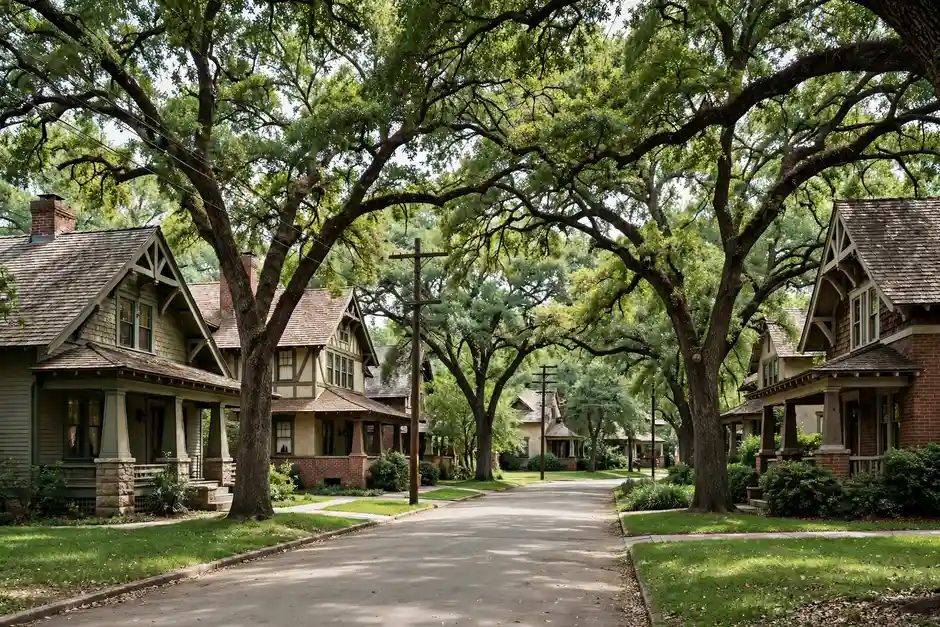
Victorian era houses with steep complex roofs in King William
King William Historic District Roofing

The Certificate of Appropriateness, first

In King William, any exterior modification or repair to a property with a historic zoning overlay needs a Certificate of Appropriateness from the Office of Historic Preservation — even work not readily visible from the street. The CoA sits alongside the City re-roof permit; it does not replace it.

Most requests are approved administratively by OHP staff — a Specialist-on-Duty or case manager. New construction, additions, and anything outside the Historic Design Guidelines go to the Historic and Design Review Commission for a public hearing. The CoA step is built into the schedule before any work is booked: a roof stripped before its CoA is approved is a problem no one can fix cheaply.

Book a visit →
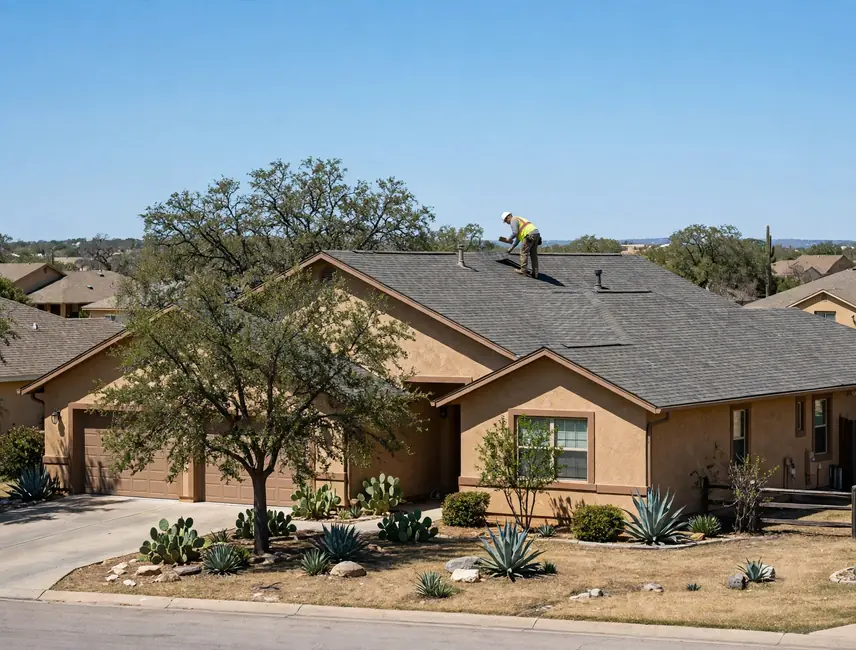
Roofing crew reviewing a written scope before work starts
King William Historic District Roofing

In-kind replacement, and tile salvage where it matters

The Guidelines say to replace roofing materials in kind whenever possible, and to retain and re-use historic materials when large-scale replacement of non-asphalt materials is required. Salvaged slate, clay tile, or cement tile goes back on the roof forms most visible from the public right-of-way.

An exact match is the goal, and when it cannot be had, the new material must carry the same scale, colour, texture, profile, and style — or at least sit comfortably with the building's style. That matching step — finding the profile, the colour, the texture — is real work, and it happens before the order, not on the day the crew arrives.

Book a visit →
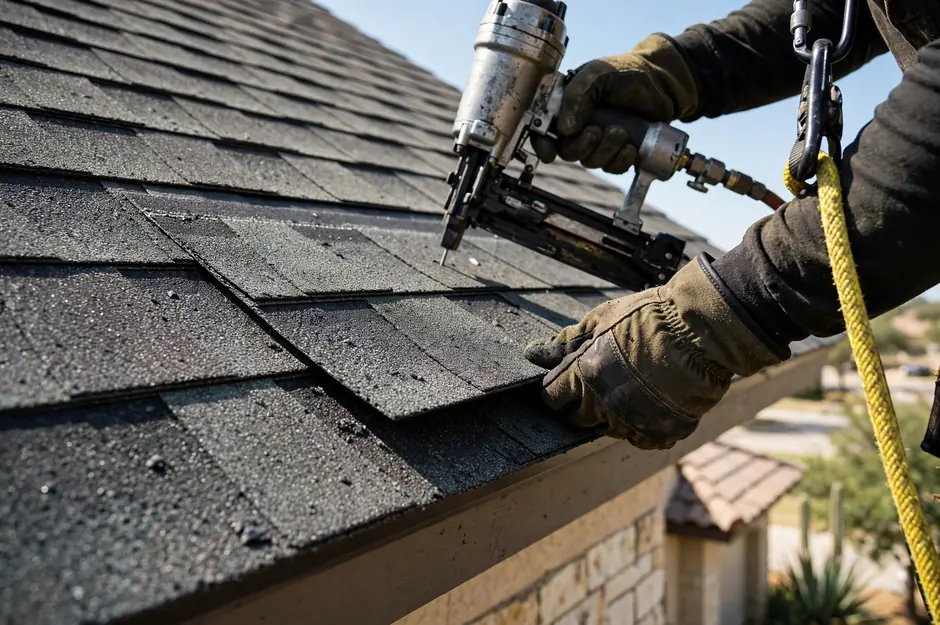
Slope by slope roof inspection on a historic home
King William Historic District Roofing

Steep, complex roofs with features worth keeping

King William’s roofs are steep and complex by design: turrets, bays, dormers, flared eaves, decorative purlins, and brackets with shaped ends. The Guidelines require those features to be preserved and repaired, not removed for convenience.

That complexity changes the work itself — staging, fall protection, and hand work around features a modern tract roof never has. It also changes the inspection: each slope, each feature, and each flashing detail gets documented, because the CoA application and the repair scope have to describe the same roof.

Book a visit →
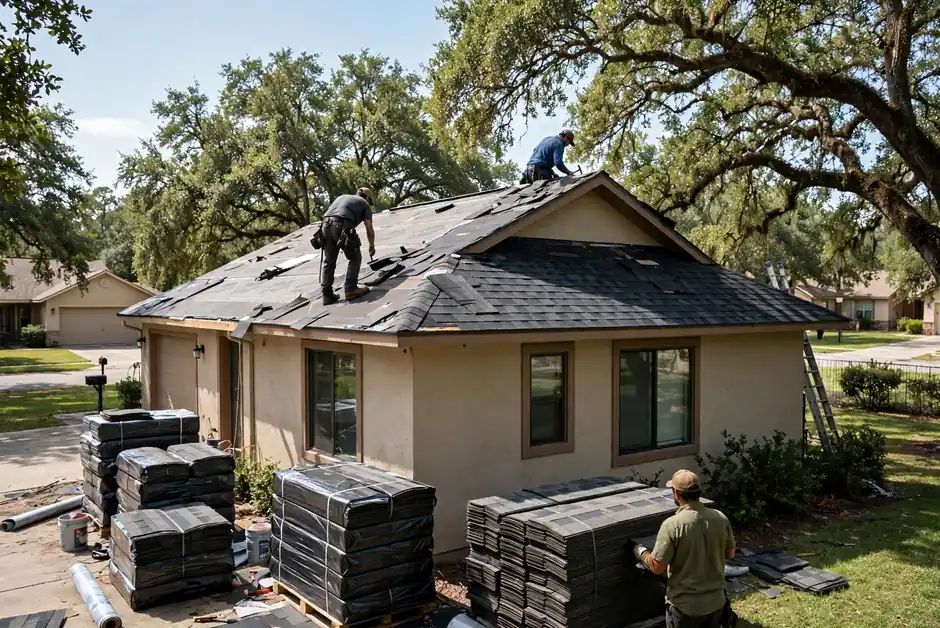
Juarez contracting & innovation LLC team
Early warning signs

Signs You Need Roofing in King William Historic District

01Patterned shingles missing or slipped on a turret or bay

02A cracked or slipped clay or cement tile on a Victorian slope

03Water stains below a dormer, valley, or chimney flashing

04Open seams in flashing, or a cornice beginning to rot

05Moss or retained moisture building up on a shaded King William slope

Have us take a look →
We know the route

Navigating King William Historic District: Landmarks We Use

King William sits along the San Antonio River just south of downtown, next to Southtown and Lavaca. We use the river, the Steves Homestead, and the Southtown arts corridor as the routing references — and the district’s own street pattern, which predates the grid around it.

JKing William Historic District

San Antonio River

The river runs along the district’s edge and is the reason King William is where it is. It is the first reference we use when routing a crew into the neighbourhood.

JKing William Historic District

Steves Homestead

The Steves Homestead, dating to the 1870s, is one of the district’s landmark houses and a reminder of the German merchant era that built these roofs.

JKing William Historic District

Harnisch House, 1884

The Harnisch House from 1884 is another of the district’s early homes, with the steep roof forms and period detailing that define King William roofing work.

JKing William Historic District

Southtown

Southtown sits immediately next to King William along South St. Mary’s and South Alamo. Its arts corridor and the Blue Star complex mark the district’s northern approach.

KING WILLIAM HISTORIC DISTRICT
AREA
JJJJJ
Primary King William Historic District response zone
King William Historic District service coverage

Is your street on the route?

King William is the historic district along the San Antonio River just south of downtown, in the 78204 area, next to Southtown and Lavaca. Houses with a historic zoning overlay follow the CoA rules on this page — call us and we will go over what your address needs before anything is booked.

Popular neighborhoods

King William · Southtown · Lavaca

See all areas we serve →

Check my address →
Reviews from Google

What San Antonio Homeowners Say

4.8★★★★★19 Google reviews

These reviews come from the business’s Google profile.

★★★★★
“Found their ad on marketplace, super quick feed back. Gentlemen stopped by same day to inspect roof. This company is extremely professional and quick. They had our roof done in 2 days. Great price point and easy to work with. Thank you Juarez Contracting.”
AV

Alethia VelazquezGoogle review · Roofing

Google
★★★★★
“Chris was professional, on time for the estimate, very informative about what needed to be done,and willing to work with me. Thank you for a job well done.”
BS

Belinda SalinasGoogle review · Roofing

Google
★★★★★
“Very fast estimate and fixed within 24 hours of asking them for help. Very fast and very reliable. My roof looks great!”
JK

Jamie KGoogle review · Roofing

Google
King William Historic District Roofing FAQ

FAQs About Roofing in King William Historic District

Our team can help if your question is not answered here — ask about your King William roof and the historic-district process when you call.

Call (254) 329-0299 →

Yes, in almost every case. All exterior modifications and repairs to a property with a historic zoning overlay need a Certificate of Appropriateness from the Office of Historic Preservation, and the CoA is required in addition to the City building permit. OHP staff approve most requests administratively; work not consistent with the Historic Design Guidelines goes to the Historic and Design Review Commission at a public hearing. Check your property’s overlay and the district boundary before you book any work.

Only with approval, and it is a discretionary decision. The Guidelines say to replace materials in kind whenever possible, and metal belongs where the structure historically had a metal roof or where it is appropriate to the style and period. A shingle-to-standing-seam-metal change in King William went to the HDRC in 2023 as case 2023-014. Expect a hearing, not a rubber stamp.

The Guidelines say to retain and re-use historic materials when large-scale replacement of slate, clay tile, or cement tile is required, and salvaged materials should go back on the roof forms most visible from the public right-of-way. We salvage what is sound, match what is missing, and put the originals where the street sees them.

The source is the Historic Design Guidelines: consider replacement when more than 25 to 30 percent of the roof area is damaged, or 25 to 30 percent of tiles or shingles are missing or damaged. That applies to King William and other historic-district properties only — it is not a citywide code rule, and not an IRC rule. It frames the repair-versus-replace decision; it does not make it for you.

No. Designation does not change the property’s use and does not require the owner to restore the property. But if you elect to do exterior work, it requires OHP and HDRC review and approval. That is the distinction that matters: nothing is forced, and everything exterior is reviewed.

Juarez contracting & innovation LLC ready to serve King William Historic District
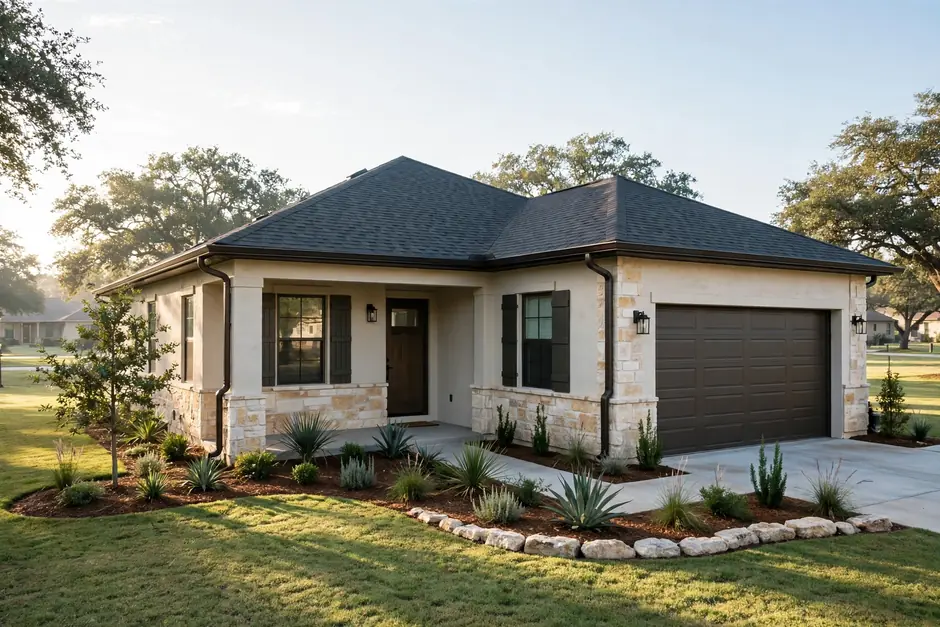
King William Historic District team is ready

Need Roofing in King William? Start With the CoA.

Call (254) 329-0299 during business hours. Our inspection covers the roof and the district’s rules, and the written scope we give you reflects both. No pressure, no surprise add-ons.

Book King William Historic District service →Mon–Fri 8 AM–6 PM (Wed to 6:30 PM) · Sat 8 AM–12 PM · Sun Closed
Request King William Historic District service

Send the details. We’ll handle the next step.

Tell us what you are seeing on your King William home and where it sits in the district. Our team will call to confirm the right appointment type and timing.

King William Historic District service hubSan Antonio, Texas(254) 329-0299Monday–Tuesday 8 AM–6 PM, Wednesday 8 AM–6:30 PM, Thursday–Friday 8 AM–6 PM, Saturday 8 AM–12 PM, Sunday closed
Request received — we will call you shortly.
↗
Questions?Call now